
Strait of Hormuz Disruption and the Long Tail of Higher Oil Prices
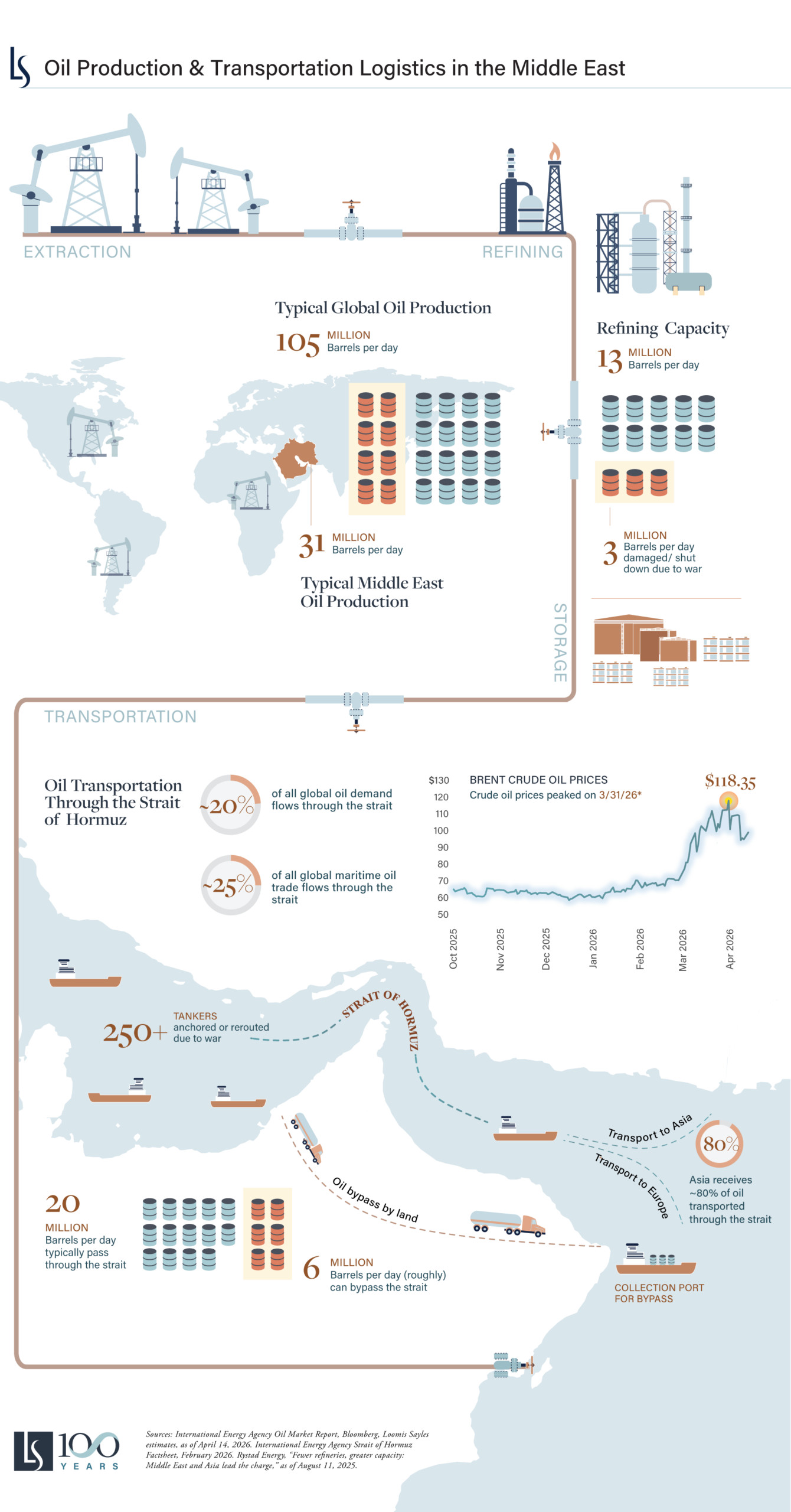
The war in Iran has caused one of the largest physical disruptions in the history of global energy and industrial inputs. The International Energy Agency’s Fatih Birol called it bigger than the 1970s and the 2022 shocks combined.i Energy infrastructure in the Middle East sustained significant damage in the first weeks of the war. Restricted flow out of the Strait of Hormuz has tightened global energy supply. Oil production has shut down in parts of the Middle East because oil has nowhere to go and storage tanks are filled to capacity.
If and when the US and Iran reach a lasting peace agreement, it will likely take weeks to months for supply to normalize. Until then, we believe the floor for oil prices will remain well above pre-conflict levels.
The graphic below illustrates the mechanics and scale of the disruption in the Middle East:
The Path Forward
Even in an immediate “stable” environment, we see a number of factors that are likely to keep pressure on short- and medium-term oil prices.
- Refinery damage. Repair of damaged oil refineries and other energy infrastructure in the Middle East will take time. Audun Martinsen, Head of Supply Chain Research at Rystad energy, estimates that while some assets in the Middle East may be restored within months, others could remain offline for years.
- Oilfield reopening. Oilfields can reopen once storage in the Middle East (which is currently full) starts becoming available. I believe it could take two to eight weeks for them to open back up as traffic slowly starts to normalize and storage starts to drain.
- Rerouting logistics. In my view, it will likely take several weeks for ships that were rerouted away from the Strait of Hormuz to return to the area once it is deemed safe to do so. Add several more weeks for tankers to fill up and reach their final destination.
- Inventory rebuilding. Oil-importing countries will likely want to rebuild oil inventories after the conflict, keeping demand elevated in the short term.
Endnote
i Le Figaro, “Fatih Birol, directeur de l’Agence internationale de l’énergie: «La crise actuelle est plus grave que celles de 1973, 1979 et 2022 réunies,” by Armelle Bohineust, published April 7, 2026.
Disclosure
Market conditions are extremely fluid and change frequently.
Commodity, interest and derivative trading involves substantial risk of loss. This is not an offer of, or a solicitation of an offer for, any investment strategy or product.
This blog post is provided for informational purposes only and should not be construed as investment advice. Any opinions or forecasts contained herein reflect the subjective judgments and assumptions of the authors only and do not necessarily reflect the views of Loomis, Sayles & Company, L.P. Information, including that obtained from outside sources, is believed to be correct, but Loomis Sayles cannot guarantee its accuracy. This material cannot be copied, reproduced or redistributed without authorization. This information is subject to change at any time without notice.
8888275.1.1
Author
